
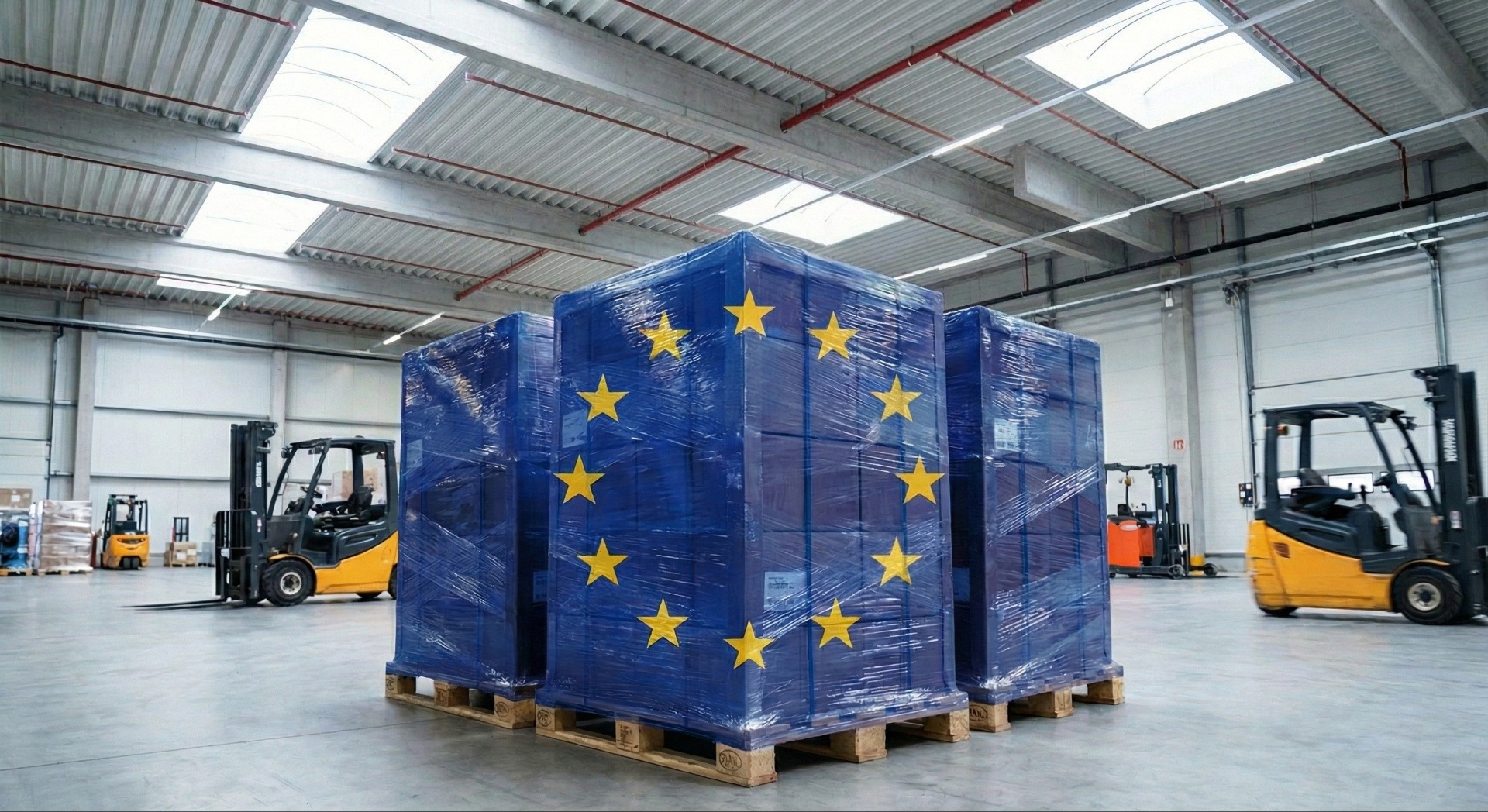
On February 25, 2026, the European Commission officially adopted a delegated decision, signed by the President of the Commission herself, granting a historic exemption. Economic operators using pallet wrapping film and strapping are now exempt from the untenable 100% reuse requirement imposed by Regulation (EU) 2025/40.
Trying to eradicate single-use plastic without taking industrial realities into account is a recipe for disaster. Today, the facts prove us right.
The wall of economic reality
The regulation initially stipulated that, from 2030 onwards, economic operators using these transport packaging formats would have to aim for 100% reuse for transport within the same company or between related or partner companies within the EU, as well as for transport between companies within the same Member State.
A technical and financial aberration for securing pallets!
Faced with the evidence, the Commission had to use its power of derogation provided for in Article 29(18), citing the "particular economic constraints" of our sector. And with good reason, as the figures speak for themselves and shatter the sweet illusions of degrowth:
- 600,000 logistics companies in the EU would have been hit hard by Articles 29(2) and (3) of this regulation.
- 610 million euros: that is the astronomical estimate of the initial costs that these logistics companies alone would have had to bear. And this figure does not even take into account the manufacturing sector, which would have caused the overall bill to skyrocket!
- Unjustifiable additional costs: These expenses would have been used to maintain duplicate packaging lines, purchase new, overpriced automated machines, replace computer equipment, and train staff.
The admission of failure of "magic technology"
Even more telling, the European text implicitly admits that the legislative rush was disconnected from reality. The Commission acknowledges in black and white that the transition to 100% reusable films and straps would require investment in automated solutions that "are not yet sufficiently developed." Worse still, it admits that this forced transition could simply have "disrupted supply chains." According to the Commission, "Such a change could therefore disrupt supply chains and entail costs for economic operators, mainly those using transport packaging."
The European Commission is not only the guardian of the Treaties. It has shown that it can also be the guardian of competitiveness and our European industrial sovereignty when the driving forces of the economy are listened to.
Seeking to impose a technological solution that does not exist on an industrial scale, at the risk of crippling the European economy: this perfectly sums up the institutional plastic bashing that we fight against every day at Plastalliance.
Plastic remains indispensable
The protection and stabilization of products on pallets does not tolerate amateurism. Stretch film and plastic straps fulfill a safety and efficiency mission that no alternative can currently match on a large scale without skyrocketing costs.
This decision, which will come into force 20 days after its publication in the Official Journal of the European Union, sends a strong signal. It proves that when industry stands together and demonstrates the economic absurdity of certain measures, the technocratic machine can reverse course.
Let us rejoice in this victory, but remain vigilant. The fight to rehabilitate plastic and industrial logic continues!