
Plastalliance

The Strait of Hormuz is closing: faced with global turmoil, France must stop its own industrial decline

• March 3, 2026 • by Joseph TAYEFEH
The Strait of Hormuz is closing: faced with global turmoil, France must stop its own industrial decline
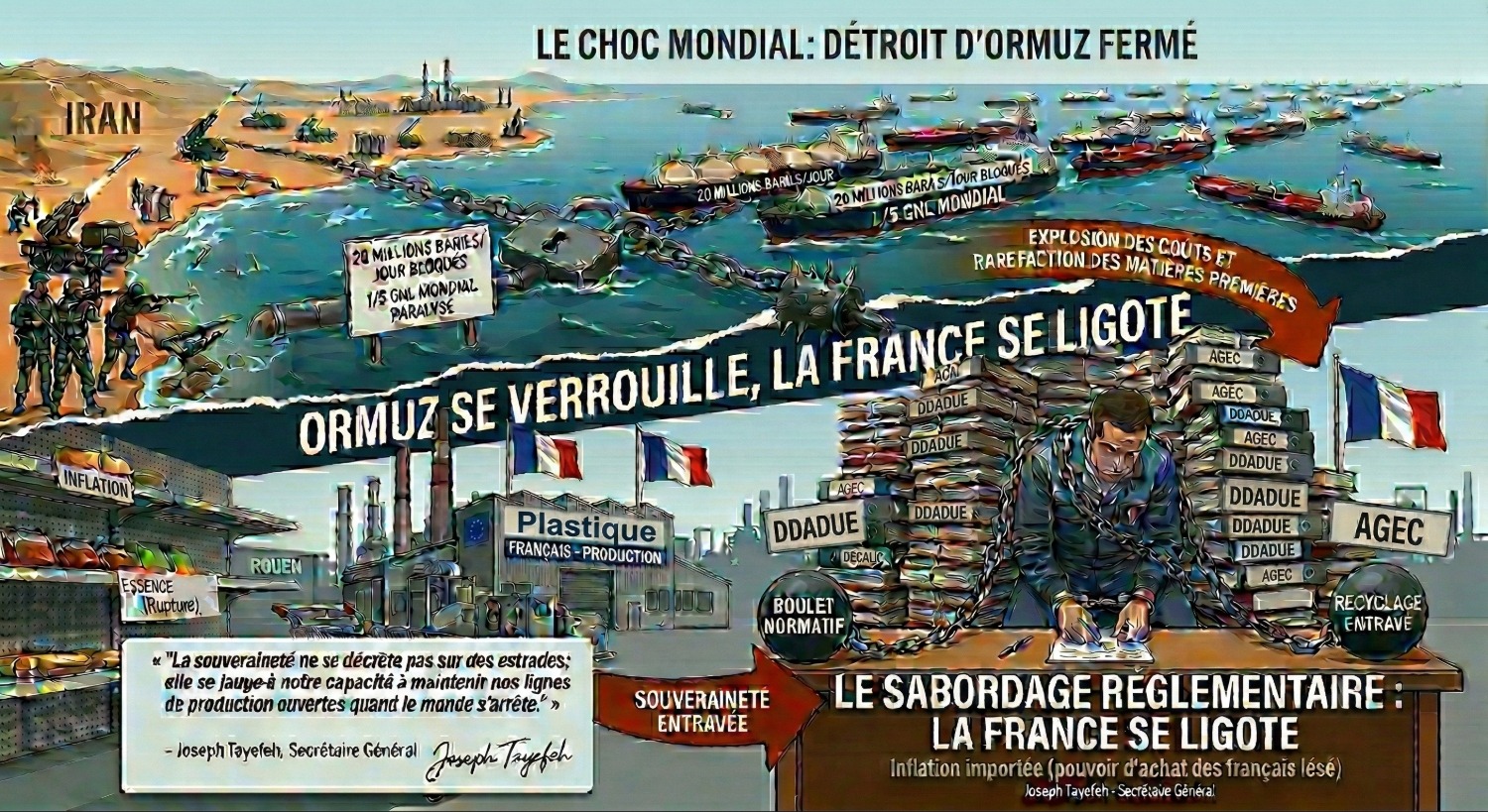
Here we are. No one can feign surprise or downplay the conflagration in the Middle East anymore. What was once a latent threat has become a brutal reality in early March 2026: with the military escalation between Iran, Israel, and the United States, the Strait of Hormuz is effectively locked down.

Foreign ministries are in turmoil, military experts are monopolizing television screens, but the real shockwave, silent and relentless, is economic. When the Revolutionary Guards block passage, shipowners halt their vessels, and global insurers simply cancel their coverage, it is the jugular vein of global industry that is severed. Nearly a fifth of the world's oil and a fifth of its liquefied natural gas are trapped there. The danger that was thought to have been averted has returned: a major, violent, and immediate supply shock.

In this storm, the real economy—that of plastics and composites—is taking the full brunt of the wave. Our raw material, which is overwhelmingly derived from petrochemicals, will inevitably suffer from the explosion in oil prices. Yet our materials are everywhere: food packaging, automotive components, aeronautics, medical equipment. This increase in our production costs will spread like wildfire across a myriad of downstream sectors. Imported inflation will once again hit shopping carts and the purchasing power of French consumers.

The triple punishment: our regulatory masochism must stop

But in addition to this double global penalty (logistical and energy-related), French industry is imposing a third, purely endogenous penalty on itself, which, let's be frank, is deadly.

While the world is in turmoil and our international competitors are securing their positions at all costs, France persists in burdening its manufacturers with regulatory constraints that we are the only ones in the world to impose on ourselves. The frenzied over-transposition of European texts (as illustrated by the DDADUE bill) and the punitive, dogmatic, and blind accumulation of AGEC laws are now tantamount to economic suicide. Let's call a spade a spade: this is a deliberate act of sabotage orchestrated by our own administration.

The irony of this situation is cruel. To free ourselves from the dictatorship of oil, there is an alternative, and it is industrial: recycled plastic, particularly in packaging (which accounts for more than 40% of our sector). But structuring a massive and sustainable resource is a colossal challenge. The reality on the ground is relentless. How can you expect our companies to invest millions of euros in the circular economy and recycling capacity when, at the same time, the French government is doing everything it can to ban single-use plastic? We are being asked to survive a global tsunami, while being forced to step into the ring with our hands tied behind our backs by absurd administrative constraints.

The time of repeal

This geopolitical shock must sweep away our naivety. The famous "industrial sovereignty," a mantra repeated ad nauseam by the executive branch on the campaign trail, today reveals its profound hypocrisy. Sovereignty cannot be decreed in ministries; it is measured by our ability to keep our factories running when the world comes to a halt.

Such an international shock cannot be absorbed without loosening the national stranglehold. Since the government cannot indefinitely compensate for the explosion in energy bills with debt-financed public checks, it must use the only free, immediate, and effective lever at its disposal: radical simplification.

The urgent need for action demands the repeal of French measures that contravene European law and the most punitive provisions of the AGEC law. The longer this Middle East conflict drags on, the more our factories will be suffocated. The urgent need to act to free our businesses is no longer just rhetoric; it is a matter of survival.

The Strait of Hormuz is effectively closed. France, for its part, must finally open its eyes to its own self-sabotage.


On April 8, 2026, the Council of State issued a landmark ruling in favor of Plastalliance: the highest administrative court overturned the government decree that sought to ban plastic containers from our school cafeterias by simply striking down its legal definition.

Behind the legal jargon (the annulment of Article D. 541-338 of the Environmental Code), the message sent by the judges is clear and scathing. The government erred through overzealousness and dogmatism. The State has, moreover, been ordered to pay 3,000 euros to our union.

Here's why this decision is so important.


Breaking news for the French government: reusable isn’t the same as single-use!

To justify this witch hunt against plastic containers, the government has long used the European Union as a shield. The argument? “It’s Brussels’ fault.” The Council of State has just shattered that excuse.

The courts have reaffirmed a point that Plastalliance has been emphasizing for years: the 2019 European directive explicitly targets only the reduction of single-use plastics (and even then, only certain items such as straws, stirrers, etc.). By attempting to indirectly ban reusable and durable plastic containers, France has engaged in excessive and illegal transposition of the directive. Reusable plastic is a pillar of the circular economy; it has every right to be in our cafeterias.

By attempting to enforce this ban by force, the government created a “technical regulation” that affects economic trade and the internal market, without even bothering to notify the European Commission in advance. Was it afraid of the Commission’s reaction and chose to ignore it? This major procedural error is now the reason for the regulation’s annulment.

The Ruin of Mayors and the Broken Backs of Cafeteria Workers

Beyond the law, it is the reality on the ground that prevails. Set to take effect in 2028 in municipalities with fewer than 2,000 residents, this ban was a financial and social time bomb.

Replace plastic? Fine, but with what—and at what cost? Glass, steel, aluminum, and ceramics are produced by highly energy-intensive industries that rely heavily on fossil fuels. Their costs are skyrocketing. Imposing these materials on small communities would condemn them to astronomical expenses they can no longer bear. Not to mention the transportation and fuel costs for washing operations when these aren’t handled in-house—costs that rise as the weight being transported increases. This isn’t theory; it’s physics.

And what about the people involved? Just ask the school staff! Replacing plastic food trays with stainless steel or glass ones means carrying much heavier loads at arm’s length every day. It turns mealtime into an unbearable cacophony for both the staff and our children.

Proof from the hospital: plastic is safe

Clear proof of the absurdity of this anti-plastic campaign: the Council of State left untouched the exemptions that the decree provided for pediatric, obstetric, and neonatal services.

Here is a list of the plastic products covered by this list:

“1. Containers that constitute a medical device as defined in Article L. 5211-1 of the Public Health Code;

“2. Containers used to ensure an adequate level of safety and hygiene for individuals requiring sterile food;

“3. Containers for prepackaged processed products, as defined in Article 2 of Regulation (EC) No 852/2004 of the European Parliament and of the Council of April 29, 2004, on the hygiene of foodstuffs, and in Article 2 of Regulation (EU) No 1169/2011 of the European Parliament and of the Council of October 25, 2011, on the provision of food information to consumers, provided they are not intended to be reheated;

“4. Food containers and substitutes as defined by Regulation (EU) No. 609/2013 of the European Parliament and of the Council of June 12, 2013, on food intended for infants and young children, foods intended for special medical purposes, and total daily ration substitutes for weight control, provided they are not intended to be reheated;

“5. Teats and bottle rings;

“6. Films used as lids, covers, and other closure devices, as well as seals, provided they are not intended to be heated;

“7. Cutlery, provided that the plastic component has been designed to eliminate any risk of injury to young children;

“8. Containers in which the plastic component designed for ergonomic purposes or to provide a thermal or sound barrier does not come into contact with food.”

Why? Because plastic remains the safest, most hygienic, and most suitable material for critical environments. If it is essential and safe for our infants in the hospital, by what miracle would it suddenly become toxic for 6-year-olds at school? Let’s remember that plastic containers have always been permitted in prisons, healthcare facilities, festivals, and fast-food restaurants. Science and logic have ultimately prevailed over ideology.


The only ones who didn't look away

In this fight, it is worth highlighting an uncomfortable truth: Plastalliance was the only industry organization to step up and defend this sector. Where others chose to give up, bow down, or simply look the other way—believing the battle was lost before it began in the face of the media and political steamroller—we refused to abandon our manufacturers and local communities. We chose to fight back, relying on legal rigor and scientific truth. This outcome proves that we must never give in to fatalism.

What now? We're keeping a close eye on things

With the repeal of the container regulations, the entire ban has collapsed. Local governments, both large and small, now have complete freedom to choose the material they deem most appropriate, most ergonomic, and most cost-effective for their cafeterias.

If the government insists on pushing ahead and drafting a new decree, it has been warned: this time, it will be subject to rigorous scrutiny by the European Commission. And Plastalliance will be there.  

The Council of State didn’t even need to consider our other arguments (including the violation of the new European PPWR regulation on packaging) to overturn the ruling. We therefore still have all our options open.

Plastalliance will continue to tirelessly defend the industrial sector, jobs in France and Europe, and the autonomy of our regions in the face of the excesses of punitive environmentalism.