
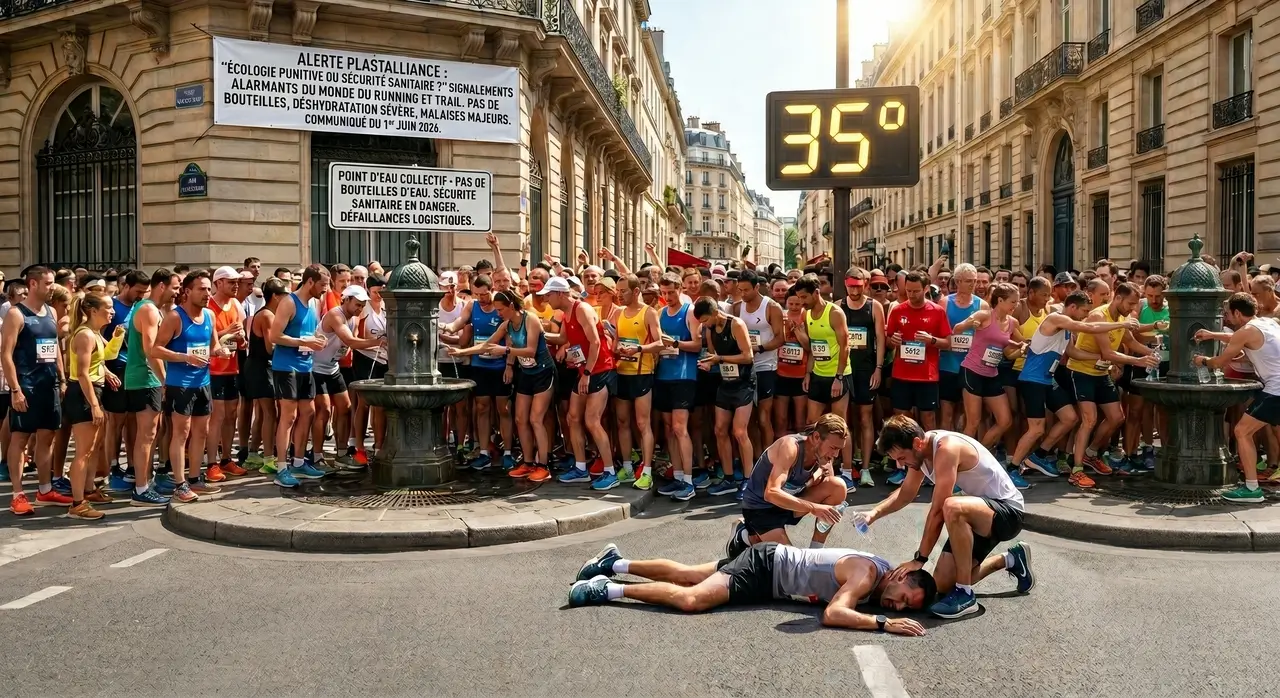
As the summer heat approaches, a trend is causing serious concern among the running community and civil society observers: the systematic and dogmatic elimination of disposable plastic water bottles from aid stations at major road and trail races, under the guise of environmental virtue.
An article published on May 26, 2026, by the specialized media outlet u-Trail and titled“Heat: The elimination of water bottles at races for environmental reasons endangers runners’ health,” highlights an unsustainable reality on the ground: in sweltering heat, the absence of individual, lightweight, capped water bottles that can be quickly distributed to runners leads to serious logistical failures, cases of severe dehydration, and major health issues. Forcing athletes to carry excessive water supplies or to crowd around insufficient communal water stations constitutes a flagrant breach of the organizers’ duty of care.
In light of this, we condemn an ideological drift in which political posturing takes precedence over the physical safety of citizens.
The plastic bottle is not a public enemy; it is a vital tool for public health and safety. Seeking to ban them from sporting events during heat waves is a grave case of ideological blindness. Polymer plastic offers something no other solution can: the guarantee of sterile, individually packaged water that can be transported effortlessly and is instantly available to prevent heatstroke. Rather than banning an indispensable and fully recyclable container, let’s focus on the logistics of collecting it and recycling it 100% on-site. Ecology must serve humanity, not sacrifice it on the altar of symbolism.
I would like to point out that, contrary to simplistic stereotypes, plastic serves fundamental public utility functions, particularly in the medical, food, and safety sectors. Forced substitution with ill-suited alternatives, such as open cups or overcrowded aid stations, poses obvious health risks in situations of extreme exertion.
A CALL FOR A RETURN TO COMMON SENSE
Plastalliance formally urges sports event organizers, municipalities, and the Ministry of Sports to base their refreshment protocols on a genuine analysis of health risks rather than on ideological guidelines. We recommend continuing to distribute water bottles as soon as temperatures exceed warning thresholds, backed by a rigorous system for the selective collection and circular recycling of packaging at the end of its life cycle.
Finally, in light of the serious health incidents—including severe fainting spells and, tragically, deaths—recently reported at certain events, Plastalliance calls for the application of the precautionary principle and the utmost transparency. Given these tragedies, it seems legitimate to question the extent of the safety obligations incumbent upon organizers. If a causal link were to be formally established by the competent authorities, the question of potential civil—or even criminal—liability on the part of the decision-makers responsible for these restrictive measures could legitimately arise. It is now essential that the exact causes of these tragedies be fully and objectively investigated, so that the physical well-being of athletes is never compromised.