
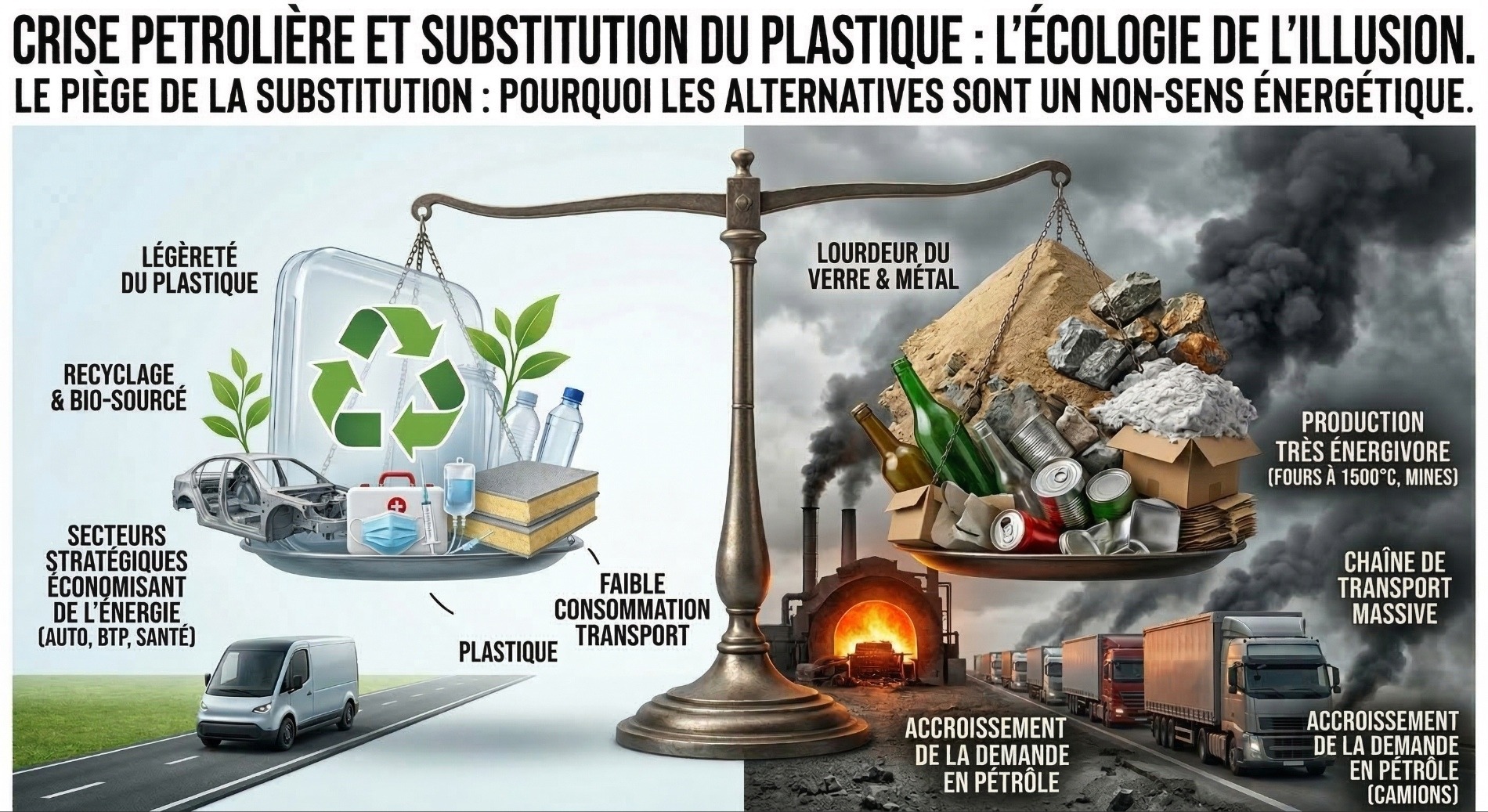
Faced with the risks of energy shortages, rising gas prices, and dependence on fossil fuels, a tempting refrain is beginning to take hold: what if the solution lay in a collective effort to “rethink” (read: “eliminate”) our consumption of plastic packaging and products? While the call for resilience is commendable, the conclusion itself borders on wishful thinking. Here’s why replacing plastic would, paradoxically, worsen our energy balance.
It is often in crisis situations that our capacity for innovation increases. But innovation must not be divorced from science. To think that replacing plastic with other materials, supposedly more "noble" or "ecological," will save us gas or oil is a serious error in analysis that comes up against the wall of physical and industrial realities.
The thermodynamic impasse of alternative materials
Let us recall a stubborn fact that is systematically ignored by plastic bashers: absolutely all alternative materials to plastic consume enormous amounts of energy, gas, or oil in their production. Worse still, unlike polymers, these materials are bound by their physical laws and can never change their fundamental nature:
- Glass: Whatever technological innovations may come in the future, the laws of thermodynamics will remain unchanged. Sand (a precious resource) will always have to be melted in furnaces heated to over 1,500°C, which are overwhelmingly powered by natural gas.
- Metal and aluminum: Mining and metallurgical processing require extreme temperatures and will remain, by nature, among the most energy-intensive industrial processes in the world.
- Paper and cardboard: Although often perceived as “green,” their production still requires astronomical amounts of water and, above all, heat (and thus energy) to dry the paper pulp.
The transportation trap: when substitution causes oil demand to skyrocket
The argument of falling demand completely falls apart when we address the issue of logistics, which is at the heart of the problem of prices at the pump.
The great environmental advantage of plastic is its lightness. Replacing plastic packaging with its glass or metal equivalent makes it considerably heavier (sometimes by a factor of 10 to 20 for a liquid container). The mathematical result is relentless: to transport the same quantity of goods, many more trucks are needed on the roads.
Heavier packaging = more trucks = more fuel consumed = a direct increase in demand for oil. Wanting to save energy by making our modes of transport heavier is complete nonsense.
The real opportunity: transforming the source for common applications
If we want to demonstrate "ingenuity and creativity" in moving away from black gold, the solution is not to eliminate plastic, but to exploit its tremendous capacity for evolution. Unlike other materials whose energy footprint cannot be reduced, plastic has the ability to change its raw material:
- Recycled plastic (fossil fuel independence): Our plastic waste is our new oil field. By massively structuring recycling, we are creating a local circular economy loop. Waste becomes a resource, which allows us to cut off the supply of virgin oil extraction while maintaining the lightness of the material.
- Bio-based plastics (the plant-based alternative): For a wide range of applications, the industry is now capable of producing high-performance polymers from biomass, thereby completely moving away from traditional petrochemicals.
Strategic sectors: where fossil-based plastics are here to stay
However, we must be intellectually honest and admit that while many of our practices (such as packaging) can and must transition to recycled or, in certain applications, bio-based materials, other sectors will not be able to do without fossil-based plastics in the near future. This is not a failure, but an absolute technical necessity.
- The medical sector: Blood bags, syringes, heart valves, and operating room equipment require virgin polymers of absolute purity. In this field, single-use fossil-based plastic is not a matter of consumer convenience; it is a vital bulwark against hospital-acquired infections.
- Automotive and aerospace: High-performance engineering polymers make vehicles and aircraft lighter. Herein lies the paradox: using these fossil-based plastics in manufacturing saves millions of barrels of oil in fuel over the lifetime of the vehicle.
- Construction (building and public works): Thermal insulation materials (such as polyurethane or expanded polystyrene) are our most effective weapons against heat loss. They require petroleum for their manufacture, but drastically reduce our consumption of gas or fuel oil for heating for decades. The return on energy investment is enormous.
Pragmatic ecology versus the ecology of illusion
The real opportunity today is not to give in to ideological posturing by turning to materials that will remain, in essence, dependent on massive energy expenditure, nor to demonize a material when it is the only one that can guarantee our safety or thermal performance.
True environmental solidarity requires political courage and scientific rigor: accelerating the transition to recycled and bio-based plastics wherever technically and economically feasible, maintaining their use where strategically necessary, and systematically basing decisions on the life cycle assessment (LCA) for each product. Anything else is just an illusion.